If you blog it they will come?

Wednesday, January 28, 2009

Company Profiles

Ever since working for software companies which were spinoffs of other software companies which were spinoffs of other software companies, I've wondered what a tech company family tree would look like.

Although it runs slowly in the browsers I've tried, this map reveals an amazingly thorough time and space relationship graph for Puget Sound tech companies.

On top of this, LinkedIn has beefed up their company profile pages with illuminating statistics such as incoming and outgoing career paths. Plus, statistics on  median age of employees and breakdown of which titles constitute which percentage of company employees sheds light on facts which previously would have required some form of insider knowledge.

Now, for example, I know that prior to joining Microsoft, employees often worked for HP or Oracle, and after leaving tend to arrive at Amazon or Yahoo. I also learned that median age of a Microsoft employee is 34 years old and 13% of its nearly 90,000 employees are software engineers.

Its juicy information like this which I covet for visualization purposes--perhaps simultaneously depicting the flow of workers in and out of a company as well as size and age. I'll have to see if I can snag myself an API partnership.

Tuesday, January 13, 2009

"Artifacts" of taking Graphics/Computer Vision courses

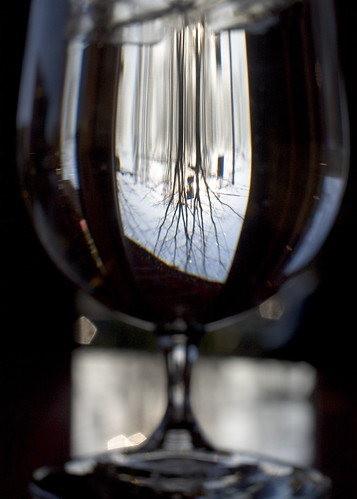
from http://flickr.com/photos/csb13/99025844/

  • When I am in a restaurant I sometimes notice the reflection and refraction of lights and objects through my water glass and try to trace the beams or other objects back to their origin. This is especially true in restaurants with colored lighting.


  • When I am walking around areas with lots of solid geometry like between passageways of buildings on campus, I sometimes imagine that the world is translating or transforming instead of me, the viewer (since they produce equivalent images often the approach in graphics is to shift the entire world). I might sometimes figure out where the vanishing points are relative to all the edges and corners.


  • I am aware of my internal edge sharpening and occasionally notice the effects of mach banding, both phenomenons which occur as the result of signal processing built into the wiring of the rods and cones of the eye itself.

Monday, January 12, 2009

Diving into "Dive Into Python"

Well I'm now five chapters deep in Dive Into Python, which is available completely for free as a PDF.

It's an older book, but still relevant for its unusual and fantastic approach of teaching a new language to experienced programmers. The approach seems so obvious, and yet it's difficult to come up with examples of other titles which follow the same approach.

Guido

Each chapter begins with a short code example which highlights the power of Python while performing non-trivial tasks such as outputting the language's own documentation or displaying directory listings with file metadata.

These examples highlight the succinctness of the language while including a new language concept per chapter, effectively booting the reader into a frigid pond of fresh semi-obtuse language constructs ('Get thrown into freezing cold pond of python' doesn't have quite the same ring though).

The remainder of the chapter is always devoted simply to exposing the constructs and syntax of the example; both what and how it all works, line-by-line if necessary. Code samples are available from the website, and the chapter encourages a hands-on approach of running and modifying sample code.

At each chapter's conclusion, a checklist of concepts is presented and the semi-obtuse sample seen at its start reads as clearly as a language you've known all along.

It makes perfect sense that the best way to learn a language is by dissecting code beyond one's current reading level and then changing and authoring examples to reinforce it all. It's a bit strange that fewer books go as far as this one, but it's possible the "by Example" series follows a similar tack.

Dive Into Python's chief drawback is it's age--the book was written way back in 2003, the time of Python 2.3 (it's now the age of 2.6 and the dawn of 3.0). Still, this is a much more fun way to learn than reading, for example, Python in a Nutshell, as I was doing (it's more of a reference manual anyway, though more up to date).

Tuesday, December 23, 2008

Python Imaging Library

I've been diving into Python and trying to craft short little programs to improve my skillz.

One of the first Python extensions I made a move for was the Python Imaging Library. The PIL packs in an impressive amount of file format compatibility; loading and creating images could hardly be simpler.

For 90% of your typical use cases I'd say PIL does great, since loading saving and doing simple transformations on images is ridiculously simple. The PIL even supports drawing directly on images with polygons and other primitives. This is where my list of annoyances begins.

When you're drawing on an image, it seems only natural to desire transparency of shapes. Strangely, this is not possible. After some digging it seems the closest hack is to draw on a buffer image and then blend() or paste() with the original to achieve transparency. This is alright as long as the number of shapes are limited.

However, if you're trying to create multi-layered vector art, PIL isn't really up to the task.

In order to achieve the incremental layering of these shapes with true alpha values, I had to write my own pixel-by-pixel merge function, which was ridiculously slow. I'm sure there might have been a better way to do it but I found some of the documentation lacking, and on further investigation it's just literal comments from the source code, with few usage examples.


The above images took about a minute each to render, so there goes my plan to create a fun hill-climbing afternoon evolutionary image grinder. I might give this another stab with some Python OpenGL libraries.

Wednesday, December 3, 2008

Graphics class final project.

Well, I'm slowly but surely taking my tuition money back out of the department by snatching their various prize giveaways. Yesterday I received an Amazon gift certificate in my inbox from "The CSE Department" for qualifying in the regional ACM programming contest.

Today I took away a WALL-E 3-DISC Special Edition, an excellent and relevant reward for coming in second place in our graphics class' animation short festival. My graphics partner Robert and I built a strange little one-eyed Residents-style toaster creature which likes dancing and creating toast. Here's the full clip:


I'm also adding the original dancing clip below because unfortunately we didn't match up our video resolutions and it clipped out a lot of the detail. Here it is:


Dancing eye ball toaster from a f on Vimeo.

Tuesday, December 2, 2008

Last summer's big ol' DNS scare

An entertaining and well-written article about a crucial internet security flaw last summer:

Dan Kaminsky destroys, saves internet etc.

A scary reminder of how the entire web hinges on the security of e-mail of all things.

Monday, December 1, 2008

Opencongress.org

I just discovered Open Congress, a pretty sweet site for bringing clarity and perspective to US politics + legislation.

For example, check out the page for HR 2082, the CIA funding bill vetoed by Bush for its interrogation tactics restrictions:

H.R. 2082

You can see who voted Aye, Nay or abstain, its amendments, its trajectory through Congress (ending in a failed override) and related bills and news articles.

For example, these 4 Senators voted "Nay" on the bill:

Waterboarding fans

Unfortunately I could not locate a convenient "Contact this politician" button so that I could quickly dispatch an appropriate nastygram. At the least, it could link me to their Facebook profile (seeing as how I can "share" Senator Chambliss with all my friends on Facebook...)